Fullmetal Alchemist the Movie: Conqueror of Shamballa Directed by Seiji Mizushima Produced by Seiji Takeda Written by Sho Aikawa Music by Michiru Oshima Cinematography Susumu Fukushi Editing by Hiroaki Itabe Distributed by Shochiku July 23, 2005 Running time 105 min Country Japan Language Japanese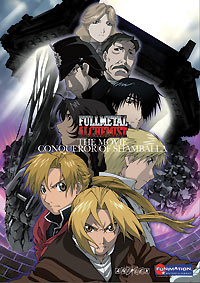
August 25, 2006
September 17, 2007
Fullmetal Alchemist the Movie:
Conqueror of Shamballa (劇場版「鋼の錬金術師 シャンバラを征く者」 Gekijōban "Hagane no Renkinjutsushi Shanbara o Yuku Mono"?) is a 2005 Japanese animated film directed by Seiji Mizushima and written by Sho Aikawa, and acts as a continuation of the Fullmetal Alchemist television series. It premiered in Japan on July 23, 2005. The Japanese DVD was released on January 25, 2006, including with it a limited edition with a special box, English subtitles and a series of other extras. The U.S. version was shown in a limited number of theaters starting August 25, 2006,[1] and the DVD was released September 12, 2006 and a limited edition November 14, 2006. The film had a re-release in theaters for one day only in select theaters on September 20, 2007.[2]
Plot
Dragged from his homeworld of Amestris to a parallel world called Earth, Edward Elric lives in Munich, Germany, in the year 1923. Stripped of his alchemical powers and some of his limbs, but not the attachments for his automail, he researches rocketry with Alfons Heiderich (アルフォンス・ハイデリヒ Arufonsu Haiderihi?) (voiced by Shun Oguri in Japanese, and Jason Liebrecht in English), a young man who resembles his brother. Alphonse Elric lost all of his memories of the events following his and his brother's attempt to resurrect their mother. He was studying alchemy under their teacher Izumi Curtis, but after her death he began seeking a way to reunite with his brother and retrieve his lost memories.
Edward encounters many people whose faces are familiar to him. He rescues a woman named Noa (ノーア Nōa?) (voiced by Miyuu Sawai in Japanese, and by Leah Clark in English), a troubled gypsy woman, who starts having visions concerning his life in Amestris. Dietlinde Eckhart (デートリンデ・エッカルト Dētorinde Ekkaruto?) (voiced by Kazuko Katou in Japanese, and by Kelly Manison in English), a member from the Thule Society, discovers the existence of Ed's world with help from Noa and starts giving him hints to how he could open a portal back to Amestris. Once Ed starts opening the portal, Dietline kidnaps Ed's father, Hohenheim, to open the last parts of the portal using the homunculus Envy as a catalyst.
At the same time Alphonse is guided by the homunculus Wrath to the underground city beneath Central City to open a portal to Earth. They are attacked by the homunculus Gluttony, who brutally fights and captures Wrath between his jaws. But Wrath asks Al to transmute the two of them so he can open the gate, Al complies. Envy and Hohenheim are both transmuted moments later, allowing the Thule Society's army and Dietlinde to travel through to Central which they attack. Ed follows in a rocket-powered plane and is reunited with Al, Winry Rockbell, and Roy Mustang. Ed, Al and Mustang fight Dietlinde while the military defeats the army. Ed returns the surviving men to Germany and to seal the gate, but to his shock, he finds Al hidden in a suit of armor. Al explains that Mustang is sealing the gate in Central, and he has also regained his memories after losing them at the end of the series.
Production
Production of the film began shortly after the television series finishing its original broadcasting on Japanese channels, although pre-production started during the show's run in March, 2004. The film's production was led by director Seiji Mizushima, who also had directed the series as well. Mizushima allowed a camera crew and interviewers into the show's conference room at the Bones studios where he described how production went, as seen in a special feature on the DVD release of the film. The conference room was filled with every cut and drawing created for the show and movie, but it was eventually cleared out to make room for other projects.[3]
The original draft of the film's script was a hundred pages long, making the film over three hours long. Sho Aikawa wrote the script. Mizushima and others had to cut a third of the script's scenes out in order to make the film an appropriate length. Some scenes and characters were removed from the final cut, including a character named Steiner who could see auras, and his role was similar to Noa's. A scene which was cut involved characters Roy Mustang and Winry Rockbell meeting in front of the late Maes Hughes' grave. It was a highly awaited scene from the perspective of the fans. By October, 2004, the script was completed and the pre-check storyboards were produced. The pre-check storyboards showed the movements of objects and characters in each shot along with the characters' lines. Production on the proper storyboards began in November of the same year, but the schedule in producing the film was immensely busy, so the directors of the film split the storyboards into six section, one for each of the directors to create.
The opening and ending scenes were drawn by Mizushima; the scene involving the debut of the film's villain was drawn by Soichi Masui; the middle section of the film was drawn by Shingo Kaneko; Edward Elric's return to his homeworld was drawn by Masahiro Ando; action scenes were drawn by Shinji Aramaki; and the epic battle between Wrath and Gluttony was drawn by Yutaka Nakamura. Mizushima was repeatedly harassed by the head employees at Aniplex to speed up work on the storyboards. A trailer was produced for the film in December, 2004 with Romi Park, the voice actor for Edward Elric, narrating it. Three posters were produced for the film, two teaser posters and a third for the release of the film. A "Fullmetal Festival" was held on December 26, 2004 to celebrate the show and film. Most of the directors finished their assigned storyboards by February of 2005, except Shingo Kaneko, who was taking longest due to the general slow process, but his storyboards were nevertheless impressive.[3]
The artwork for the film was produced once Kaneko was finished and cel-animation was used to produce several characters or items in the film. Seven-hundred of the film's animated frames had to be redone with only two weeks to the film's release. The film was released in September, 2005.[3]
Distribution
The movie premiered at Montreal Fantasia's Festival on July 22, 2006.[4] On February 27, 2006, Funimation annonunced that they licensed the film.[5] The movie was premiered on August 25 in a small number of theaters by Funimation Films with little promotion. Some only ran less than 10 showings of the film. Some promotional activity was done after the film was already gone from theaters. The movie trailer was shown to a group of about 300 persons at Shiokazecon in Houston, Texas on April 27, 2006. Vic Mignogna, the English voice actor for Edward Elric, heavily promoted the film at anime conventions.
The special edition DVD release premiered at Nan Desu Kan in Denver according to news published on their website. On the movie's MySpace it announced that the movie was going to be shown again in select theaters on September 20, 2007. It should be noted that they only showed the movie for that day only.
Soundtrack
The film's music was produced by Michiru Oshima, who worked in the music of the anime.[9] L'Arc~en~ciel gave two of their new songs for the film's opening and closing credits, "Link" and "LOST HEAVEN", respectively. The film's orchestral music was performed by the Moscow Orchestra. "KELAS [LET'S-DANCE]", the song performed by the Roma women while Edward Elric and Alfons Heiderich hitch a ride. Composed and guitar by Ferenc Snétberger, with vocals by Tayo Awosusi. A soundtrack CD of the film, Fullmetal Alchemist The Movie Conqueror Of Shamballa OST, which contained forty-six tracks, was released on December 21, 2005.[10]
Reception
During its premier, the film ranked 3rd at the Japanese box office It became the seventh most popular anime film released in Japan during 2005. In the "Tokyo Anime Fair", the film won in the categories "Animation Of The Year", "Best original story" (Hiromu Arakawa) and "Best music" (Michiru Oshima).[12] It also won the 2005 Animation Grand Award prize in Mainichi Film Awards.[13] and Best Animated Film prize in Fantasia International Film Festival (Montreal, Canada).[14] During the American Anime Awards, the film was also nominated in the category of "Best Anime Feature".[
